The global industrial landscape is witnessing a transformative shift toward smart materials, where the role of nitinol wire suppliers has become pivotal. Nitinol, a nickel-titanium alloy known for its unique shape-memory and superelastic properties, is no longer a niche laboratory curiosity but a cornerstone of modern medical devices, aerospace engineering, and high-end robotics. For procurement managers and engineers, understanding the capabilities of these specialized suppliers is the first step in unlocking the potential of adaptive hardware.
The demand for precision-engineered Nitinol is surging as industries move away from rigid components toward flexible, resilient systems that can withstand extreme environments. Whether it is a self-expanding stent in a coronary artery or an actuator in a satellite deployment system, the quality of the raw material directly dictates the safety and efficiency of the final product. This reliance puts a premium on the technical expertise and quality control standards maintained by leading nitinol wire suppliers.
Navigating the market of Nitinol production requires more than just comparing price points; it demands an evaluation of thermal processing capabilities, purity levels, and customization options. By partnering with experienced suppliers, companies can reduce the risk of material fatigue and ensure that the phase transformation temperatures of the wire are calibrated precisely to the application's requirements, ensuring long-term reliability and innovation.
Global Relevance of Nitinol Wire Suppliers
On a global scale, the availability of high-grade Nitinol is closely tied to the advancement of minimally invasive surgery and aerospace exploration. According to industry standards aligned with ISO 13485, the precision of these alloys is non-negotiable, as a deviation of even a few degrees in transformation temperature can render a medical implant useless. This has led to a concentrated network of nitinol wire suppliers who possess the vacuum induction melting (VIM) and vacuum arc remelting (VAR) technologies necessary to ensure chemical homogeneity.
The challenge facing the global market is the balance between high production costs and the need for scalability. As emerging economies integrate more advanced medical infrastructure, the pressure on suppliers to provide cost-effective yet high-performance wire has increased. This dynamic is driving a wave of innovation in drawing and annealing processes, allowing suppliers to produce thinner, more consistent wires that meet the rigorous demands of the next generation of smart devices.
Defining the Role of Nitinol Wire Suppliers
In simple terms, nitinol wire suppliers are specialized metallurgical manufacturers that produce a unique alloy of nickel and titanium. Unlike traditional wire drawing, these suppliers must manage the material's "memory," ensuring that the wire can return to a pre-defined shape when heated or exhibit superelasticity at room temperature. They act as the bridge between raw elemental minerals and high-tech functional components.
Beyond the chemistry, these suppliers provide critical "shape-setting" services. Because Nitinol's properties are altered by heat treatment, a supplier's ability to precisely control the annealing atmosphere and temperature is what defines the product's value. They don't just sell a metal; they sell a programmed physical response, which is essential for humanitarian needs such as the development of affordable, durable medical stents for underserved regions.
Furthermore, the connection to modern industry lies in the transition toward "active" materials. While traditional steel or copper wires are passive conductors or supports, the products from nitinol wire suppliers function as sensors and actuators combined into one. This convergence of material science and mechanical engineering is what allows for the creation of robotic limbs that mimic human muscle movements.
Core Technical Components of Quality Wire
The first pillar of quality from nitinol wire suppliers is Chemical Composition Control. The ratio of nickel to titanium must be precise to a fraction of a percent; a slight shift can move the transition temperature by dozens of degrees. This requires sophisticated spectrometry and a strict adherence to melt-batch consistency.
Secondly, Surface Finish and Biocompatibility are paramount, especially for medical-grade wire. Leading nitinol wire suppliers employ electropolishing techniques to remove impurities and create a stable titanium dioxide layer, which prevents nickel leaching and ensures the material is safe for long-term implantation in the human body.
Finally, Dimensional Tolerance and Mechanical Consistency ensure that the wire performs predictably under stress. Whether it is a 0.05mm fine wire or a thicker guide wire, the uniformity of the diameter and the consistency of the superelastic plateau are what allow engineers to design reliable systems without fearing premature fatigue or failure.
Performance Metrics for Material Selection
When evaluating different nitinol wire suppliers, procurement teams often look at a set of key performance indicators (KPIs). These include the Af (Austenite finish) temperature, the fatigue life over millions of cycles, and the purity of the alloy. A supplier's ability to provide a detailed Material Test Report (MTR) for every batch is a primary indicator of their reliability and technical maturity.
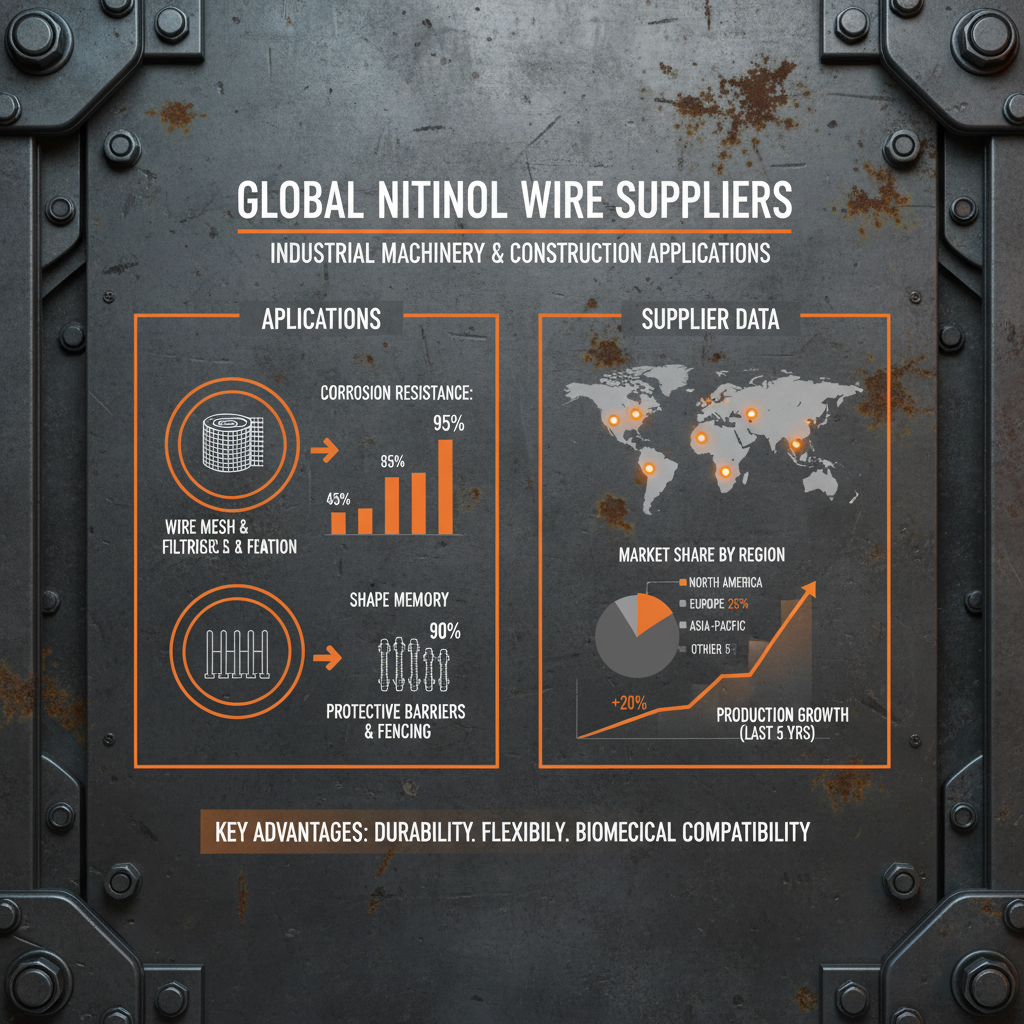
Different manufacturing methods yield different results. For instance, cold-working followed by specific heat treatments can enhance the superelastic range, while others might prioritize the shape-memory effect for actuators. The following data illustrates how various supplier specializations rank across critical performance dimensions.
Comparative Performance of Nitinol Wire Suppliers' Specializations
Global Applications and Industrial Use Cases
The practical application of materials from nitinol wire suppliers is most evident in the medical field. In the cardiovascular industry, Nitinol is used to create stents that are compressed for delivery through a catheter and then expand to their original shape upon reaching the target artery, utilizing the material's superelasticity to maintain vessel openness without the need for permanent balloons.
Outside of medicine, these materials are crucial in remote industrial zones and harsh environments. For example, in deep-sea oil exploration or space-bound probes, Nitinol actuators provide a lightweight alternative to heavy hydraulic systems. In post-disaster relief operations, shape-memory alloys are being explored for deployable shelters and adaptive bracing that can respond to temperature changes to maintain structural integrity.
Long-term Value and Strategic Advantages
Partnering with the right nitinol wire suppliers provides a strategic advantage by reducing the "failure cost" of innovation. When a material behaves predictably, the R&D cycle is shortened, and the time-to-market for new products is accelerated. The long-term value lies in the reliability; a device that does not fatigue over time creates a brand reputation of trust and safety.
From a sustainability perspective, Nitinol's durability means fewer replacements and less material waste over the product's lifecycle. This logical benefit is coupled with an emotional one: the peace of mind that comes from knowing a life-saving implant is made from a biocompatible material sourced from a certified, transparent supplier.
Furthermore, the ability to customize the transition temperature allows for "intelligent" design. Products can be engineered to trigger at exactly 37°C (human body temperature) or 100°C (industrial steam), offering a level of precision and automation that traditional metals simply cannot match.
Future Trends in Nitinol Manufacturing
The next frontier for nitinol wire suppliers is the integration of additive manufacturing (3D printing) with traditional wire drawing. This hybrid approach will allow for the creation of complex, porous structures that are still based on a high-strength wire core, enhancing the osseointegration of medical implants.
Digital transformation is also hitting the factory floor. AI-driven quality control systems are being implemented to detect microscopic surface defects in real-time, ensuring that the wire produced by nitinol wire suppliers is virtually defect-free. This automation reduces the reliance on manual sampling and increases the overall yield of high-grade materials.
Sustainability is becoming a core driver, with suppliers focusing on the recycling of scrap Nitinol. Because the alloy is so expensive, developing efficient ways to re-melt and refine used wire without losing the critical chemical balance is a major area of research that will lower costs and reduce the environmental footprint of the industry.
Analysis of Nitinol Wire Production Standards and Capabilities
| Supplier Tier |
Primary Technology |
Tolerance Level |
Certification Focus |
| Premium Medical |
VIM + VAR + Electropolishing |
± 0.001 mm |
ISO 13485 / FDA |
| Aerospace Specialist |
Precision Vacuum Melting |
± 0.005 mm |
AS9100 / Nadcap |
| Industrial Grade |
Cold Drawing / Annealing |
± 0.01 mm |
ISO 9001 |
| R&D Prototype |
Small Batch VIM |
Customizable |
Material Compliance |
| Bulk Commodity |
Standard Wire Drawing |
± 0.05 mm |
Basic Quality Control |
| Specialized Alloy |
Ternary Alloy Processing |
± 0.005 mm |
ASTM Standards |
FAQS
Verify suppliers by requesting Material Test Reports (MTRs) and checking for certifications like ISO 13485 (for medical) or AS9100 (for aerospace). A reputable supplier should provide data on the Af temperature, chemical composition (nickel-titanium ratio), and surface roughness measurements. Additionally, ask for samples to perform your own DSC (Differential Scanning Calorimetry) testing to ensure the phase transformation temperatures match your specifications.
Superelastic wire can undergo significant deformation and immediately spring back to its original shape upon unloading, without needing heat. Shape-memory wire, however, is deformed at a low temperature and only returns to its "remembered" shape when heated above its transformation temperature. Leading nitinol wire suppliers can produce both types by adjusting the heat treatment and alloying elements.
While the Nitinol alloy itself is generally biocompatible due to the titanium oxide layer, not all wires are "medical grade." True biocompatibility depends on the surface finish. Specialized nitinol wire suppliers use electropolishing and chemical passivation to remove surface impurities and nickel-rich layers, which is essential to prevent adverse reactions when the wire is implanted in the human body.
Yes, experienced nitinol wire suppliers can calibrate the transformation temperature (Af) by precisely controlling the nickel-to-titanium ratio and utilizing specific heat-treatment cycles. Even a 0.1% change in nickel content can significantly alter the temperature at which the material returns to its original shape, allowing for highly customized industrial and medical applications.
Lead times vary significantly based on customization. Standard sizes may be available in stock, but custom-drawn wires with specific Af temperatures usually require 4 to 12 weeks. This is because the process involves vacuum melting, multiple drawing stages, and precision heat treatment, all of which require rigorous quality checks at each phase.
To prevent contamination and mechanical damage, nitinol wire is typically wound on precision spools and vacuum-sealed in medical-grade plastic packaging. For highly sensitive medical applications, suppliers may use clean-room packaging to ensure the wire remains sterile and free of particulates until it reaches the final manufacturing facility.
Conclusion
In summary, the selection of nitinol wire suppliers is a critical decision that impacts the performance, safety, and scalability of any high-tech product utilizing shape-memory alloys. From the rigorous control of chemical compositions and the precision of thermal processing to the necessity of biocompatible surface finishes, the technical capabilities of the supplier are the primary drivers of a product's success. By prioritizing suppliers who adhere to international standards and offer transparent material data, companies can leverage the unique properties of Nitinol to push the boundaries of medical and industrial engineering.
Looking forward, the integration of digital quality monitoring and additive manufacturing will further refine the capabilities of Nitinol production. We encourage engineers and procurement professionals to look beyond the price per kilogram and instead invest in partnerships with suppliers who offer comprehensive technical support and customizable material properties. As we enter an era of smart, adaptive materials, the right partnership will be the key to unlocking next-generation innovations. Visit our website for more professional solutions: www.hebei-wiremesh.com